
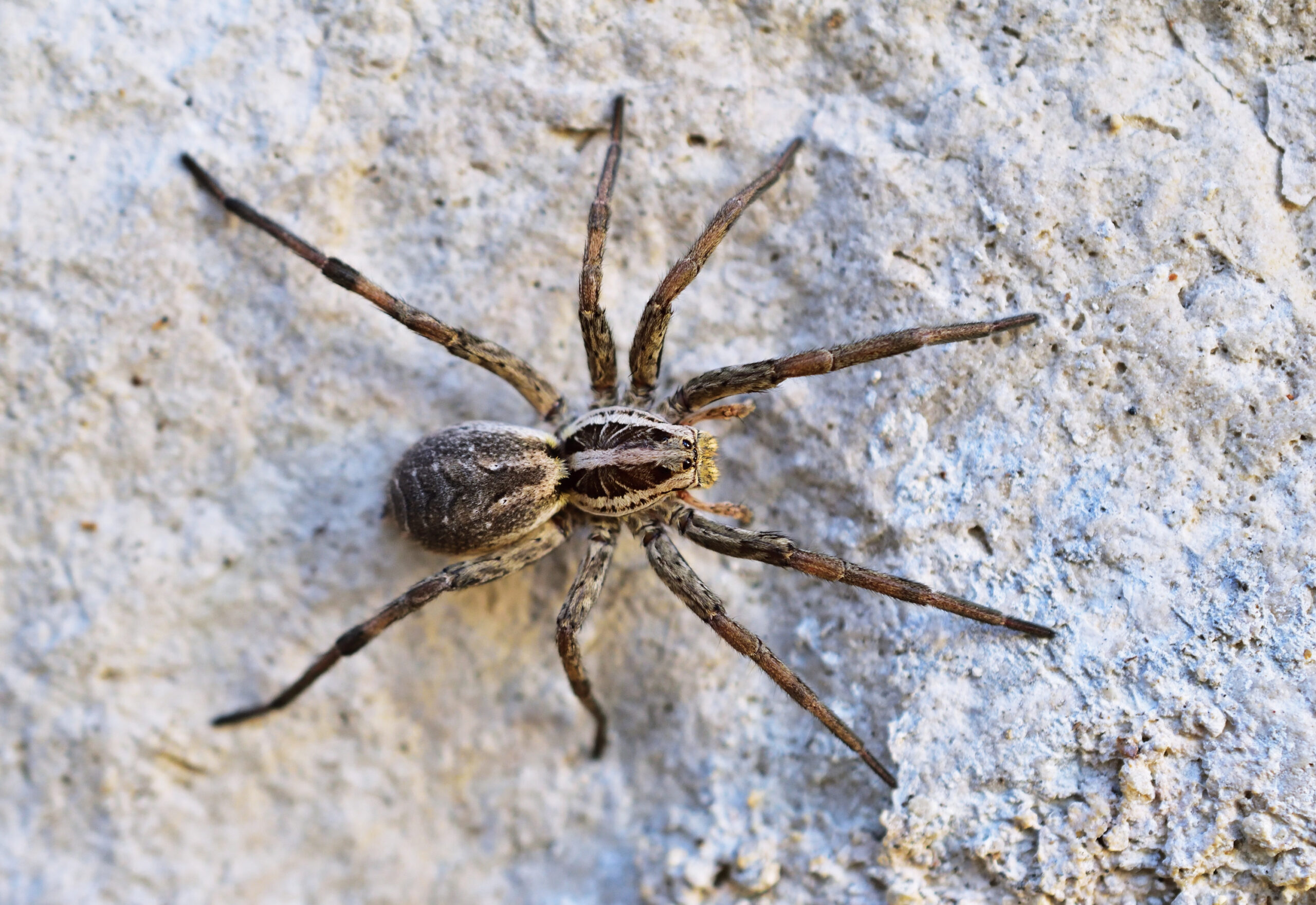
Wolf spiders usually show up around Fontana homes because warm weather, irrigated landscaping, insects, block walls, and shaded areas give them both food and shelter. Most activity starts outside in lawns, side yards, garages, planters, and around the foundation before individual spiders wander indoors through gaps beneath doors, garage seals, utility openings, and cracks. The best way to get rid of wolf spiders is to reduce the insects they hunt, eliminate exterior hiding areas, seal entry points, and use targeted exterior pest control before they begin regularly entering the house.
What Are Wolf Spiders?
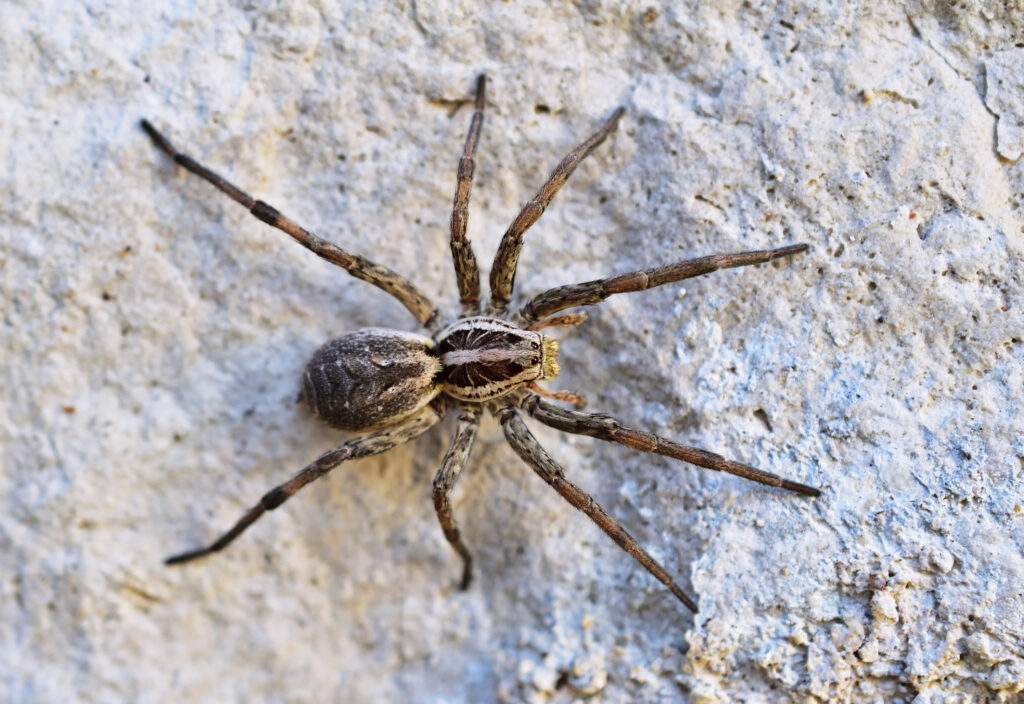
Wolf spiders are active hunting spiders that chase insects instead of relying on a web to catch their food. They are usually brown, gray, or mottled, have sturdy bodies and long legs, and are commonly found moving across the ground at night.
Unlike many web-building spiders, a wolf spider may suddenly run across a garage floor or patio because it is actively searching for prey.
Fontana Gives Wolf Spiders Plenty of Places to Hunt
A wolf spider appearing in the garage can feel random. In many cases, it isn’t.
Fontana’s long periods of warm weather allow insects to remain active around residential properties for much of the year. Add regular irrigation, decorative rock, dense shrubs, lawn edges, block walls, storage along side yards, and shaded spaces around patios, and a property can become an excellent hunting area.
Wolf spiders show up in Fontana because warm conditions and insect activity provide dependable hunting grounds, which leads them closer to foundations, garages, patios, and eventually indoor living spaces.
They commonly hide around:
gaps along block walls and fences
beneath landscape rocks and pavers
behind stored items in side yards
underneath patio furniture and grills
around sprinkler valve boxes
inside garages near walls and storage
beneath outdoor trash or recycling containers
around door thresholds
under dense groundcover and shrubs
near foundation cracks and utility penetrations
During the hottest part of the day, these protected areas can provide the shade and cover wolf spiders need.
Wolf spider problems in Fontana homes usually begin outside before spiders start wandering indoors.
It Often Starts With One Spider Near the Garage
Picture a homeowner opening the garage late in the evening and noticing a large brown spider shoot underneath a storage shelf.
They remove it and assume the problem is handled.
Several nights later, another one appears near the garage door. Then one turns up near the laundry room. A few days after that, another runs across the patio when the lights come on.
You start seeing them in multiple areas instead of one isolated spot.
That’s when you realize it’s not just one spider that accidentally wandered onto the property.
There may not be a traditional spider “nest” inside the house. Wolf spiders are generally solitary. Multiple sightings often mean the property is providing plenty of insects to eat, plenty of places to hide, and several easy routes into the structure.
Why Wolf Spiders Move From the Yard Into the House
Wolf spiders spend much of their time close to the ground, which puts them directly in the same areas where homes have vulnerable entry points.
A garage door that doesn’t seal tightly can leave just enough room for one to slip underneath. Exterior doors with worn weather stripping can do the same thing. Cracks where concrete meets the foundation, plumbing penetrations, gaps around utility lines, and openings around attached garages can all become entry routes.
Outdoor conditions can also push activity closer to the structure.
Extreme afternoon heat may drive spiders toward cooler shaded areas. Irrigation can attract insects toward lawns and foundations. Porch and garage lights can draw flying insects after dark, creating another food source near the home.
The more insect activity concentrated around the structure, the more reason a hunting spider has to stay nearby.
Wolf spider activity increases when a property continually supplies insects, shelter, and easy access around the foundation.
Why Killing the Spider You See Doesn’t Solve the Source
A shoe, vacuum, sticky trap, or store-bought spray may take care of the wolf spider standing in front of you.
That doesn’t necessarily change why it showed up.
One of the biggest mistakes homeowners make is treating each spider sighting as a separate event. If crickets, earwigs, roaches, ants, and other small insects are active around the yard and garage, wolf spiders have a steady food supply.
Spraying one spider in the garage won’t eliminate that food source.
A few sticky traps may tell you where spiders are moving, but they won’t address landscaping, perimeter insect activity, garage gaps, or hiding areas outside.
Heavy indoor spraying is also rarely the best long-term strategy when the activity is originating outdoors.
Effective bug control in Fontana needs to address the entire pest environment instead of chasing individual spiders from room to room.
The Part Homeowners Don’t Always See
Female wolf spiders have an unusual behavior: they carry their egg sac attached to their abdomen and later carry newly hatched spiderlings on their back for a short period.
That means occasionally disturbing one female can reveal many tiny spiderlings at once.
It looks dramatic, but it is also another reason identification matters.
Seeing several wolf spiders over time does not automatically mean hundreds are breeding inside your walls. More often, repeated sightings indicate favorable conditions around the property.
For homeowners searching how to get rid of wolf spiders in the Inland Empire, controlling those conditions is usually far more effective than repeatedly spraying whatever spider becomes visible.
What Actually Works for Long-Term Wolf Spider Control
Successful control starts by looking at the property from the outside inward.
The exterior should be inspected for insect activity, spider hiding locations, structural entry points, landscaping conditions, and areas where spiders are repeatedly traveling.
Reducing insects around the structure removes one of the strongest reasons wolf spiders remain nearby.
Exterior treatments can then focus on likely hunting and travel zones around the foundation, garage perimeter, patio areas, side yards, block walls, and other active locations.
Web removal is still useful because a home with heavy web-building spider activity often has significant insect pressure, even though wolf spiders themselves aren’t relying on capture webs.
Sealing gaps beneath doors and repairing worn garage weather stripping can further reduce indoor encounters.
For persistent wolf spider problems in Fontana homes, the goal isn’t simply to kill today’s spider. It is to make the property a much less productive place for spiders to hunt tomorrow.
Don’t Wait Until They’re Showing Up in Several Rooms
A wolf spider in the yard is one thing. Repeated wolf spiders in the garage, laundry room, hallway, or other indoor areas deserve a closer look.
If you’re seeing more than one wolf spider around your home, there’s likely more activity outside that you aren’t seeing.
TruPest Solutions provides fast service, local expertise, and affordable pricing for homeowners dealing with spiders and other pests throughout Fontana and the surrounding Inland Empire.
Our approach targets the exterior conditions that allow spider activity to continue instead of simply spraying the spider sitting in front of you.
Many homeowners notice a clear difference after their first service, especially when exterior insect pressure and spider activity are treated together.
For professional pest control in Fontana, CA, call TruPest Solutions at 951-334-5288.
The earlier the exterior activity is addressed, the easier it is to prevent repeated indoor sightings.
Why Spider Behavior Matters More Than Simply Finding a Bigger Spray
James, owner of TruPest Solutions, brings 18 years of pest control experience to properties throughout the Inland Empire.
Wolf spider control requires understanding how spiders behave rather than treating every spider species exactly the same.
Wolf spiders don’t sit in large capture webs waiting for prey. They move through landscaping, along walls, across patios, around garages, and through areas where insect activity is concentrated. That changes where an experienced technician looks and what conditions need to be corrected.
When James evaluates spider activity, the important questions include where insects are gathering, where spiders are hiding during daylight hours, what routes connect the yard to the structure, and why the property continues supporting them.
That real-world understanding is especially important in the Inland Empire, where intense summer heat, irrigated landscapes, block-wall construction, dry soil, and year-round pest pressure can all influence spider movement.
Why Fontana Properties Can Become Wolf Spider Hunting Grounds
Fontana has a combination of home layouts and outdoor conditions that can make wolf spider activity especially noticeable.
Properties around Sierra Lakes, Southridge, North Fontana, and established central Fontana neighborhoods may look very different from one another, but many share common spider-friendly features: block walls, narrow side yards, attached garages, irrigated lawns, decorative rock, mature landscaping, patios, and storage positioned close to the structure.
Long stretches of hot, dry weather can concentrate insects around watered landscaping and shaded portions of the property.
In newer neighborhoods, block walls and landscaped side yards can create long protected travel corridors. In older homes, worn door seals, garage gaps, utility penetrations, and established vegetation can provide additional access and shelter.
Similar conditions occur in nearby Rialto and San Bernardino, but effective Fontana exterminator service should account for the specific construction and outdoor conditions found on the property being treated.
Local pest control works best when the technician understands what Fontana homes actually look like not just what a spider identification chart says.
What Fontana Homeowners Usually Want to Know About Wolf Spiders
Why do wolf spiders keep coming back after I kill them?
Repeated sightings usually mean the conditions attracting them haven’t changed. Insects, landscaping, sheltered hiding places, and accessible garage or door gaps can continually bring new spiders toward the structure.
How can I tell a wolf spider from other large brown spiders?
Wolf spiders usually have sturdy, hairy-looking bodies, strong legs, and mottled brown or gray coloring. They are fast ground hunters and are commonly seen running rather than sitting in an organized capture web. Accurate identification is important because several spider species can appear similar at a glance.
Does finding a wolf spider inside mean I have an infestation?
Not necessarily. Wolf spiders are solitary hunters, so one indoor spider may simply have wandered inside. Repeated sightings in several locations, however, can indicate substantial exterior activity, abundant prey, or multiple entry points around the home.
What are the warning signs that the problem is getting worse?
Seeing wolf spiders more frequently, finding them deeper inside the home, noticing activity in both the garage and living areas, or seeing large numbers of other insects around the property are all signs that conditions are becoming more favorable for spiders.
Are wolf spiders dangerous inside the house?
Wolf spiders are capable of biting if trapped or handled, but they generally try to escape rather than confront people. The bigger concern for most homeowners is repeated indoor activity and determining what is allowing spiders to enter in the first place.
One Spider Can Be a Visitor. Repeated Sightings Tell You Something Else.
Wolf spiders aren’t appearing around a Fontana property without a reason.
Somewhere nearby, the environment is giving them what they need food, shelter, access, or a combination of all three. As those conditions continue, seeing another spider becomes more likely.
The most effective way to control wolf spiders in Fontana is to reduce exterior insect activity, eliminate favorable hiding areas, and stop spiders before they repeatedly move indoors.
Don’t wait until you’re finding them in the garage one week and inside the house the next.
For experienced wolf spider control in Fontana, CA, call TruPest Solutions at 951-334-5288 and get the source of the activity addressed before it becomes an ongoing problem.