
Flying ants usually appear when a mature ant colony releases reproductive males and queens to mate and establish new colonies. In Rialto, these colonies commonly begin in irrigated soil, beneath patios, along block walls, inside tree roots, or near small gaps around a home’s foundation. Getting rid of flying ants requires identifying the ant species, locating the colony, and treating the source rather than spraying only the insects with wings.
Although flying ants are often mistaken for termites, most sudden winged-ant activity around windows, patios, garages, and exterior lights is connected to an established ant colony nearby.
The important question is not only, “What are these insects?”
It is, “Where is the colony that produced them?”
What Are Flying Ants?
Flying ants are reproductive members of an ant colony. They are not a separate species of ant and they do not keep their wings permanently.
When a colony becomes mature, it may produce winged males and future queens. These ants leave the nest in groups, mate, and attempt to establish new colonies in protected locations.
The worker ants you normally see trailing across a patio or kitchen counter do not have wings. Flying ants are a sign that the colony has developed enough to reproduce.
Why Flying Ants Suddenly Appear Around Rialto
A flying-ant swarm can seem to come out of nowhere.
One afternoon, the patio looks normal. A few hours later, dozens of winged insects may be gathering near a sliding glass door, porch light, bathroom window, or garage opening.

Rialto’s hot summers, irrigated lawns, block walls, mature trees, decorative rock, and narrow side yards provide ants with protected nesting locations. Moist soil near sprinklers and air-conditioning condensation lines can also help colonies survive during prolonged heat.
Flying ants appear around Rialto homes because warm weather and available moisture trigger mature ant colonies to release reproductive members, which leads to sudden swarms near windows, doors, patios, and indoor light sources.
The swarm itself may last only a short time. The original colony, however, can remain active long after the winged ants disappear.
Flying-ant problems in Rialto homes usually begin outside and move inward through small structural openings.
A flying-ant swarm means a nearby colony has reached the reproductive stage.
Killing the winged ants does not eliminate the colony that produced them.
Where Flying-Ant Colonies Hide
The visible insects may be near a window, but the nest can be several feet away-or on the opposite side of the wall.
Around Rialto properties, flying-ant activity often begins in:
- Irrigated soil beside the foundation
- Gaps beneath concrete patios and walkways
- Cracks between a driveway and garage slab
- Hollow spaces inside block walls
- Soil beneath decorative rocks or artificial turf
- Irrigation valve boxes
- Old tree roots and buried stumps
- Areas beneath pavers
- Fence posts and landscape timbers
- Wall voids near plumbing penetrations
- Moisture-damaged window or door frames
- Attic edges and wall openings near utility lines
Ants can use remarkably small gaps to enter a structure. Common access points include worn door sweeps, window-frame gaps, weep holes, plumbing lines, cable penetrations, roof edges, expansion joints, and cracks where concrete meets the foundation.
Because the winged ants are attracted to light, homeowners frequently find them at windows even when the actual emergence point is behind a baseboard, beneath the floor, or inside an adjacent wall.
How to Tell a Flying Ant From a Termite
Flying ants and termite swarmers can look similar from a distance, especially when they are moving quickly around a window.
A closer look usually reveals several differences.
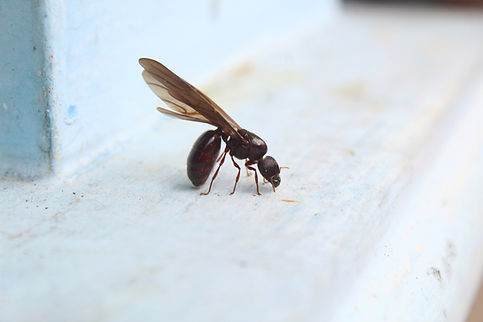
Flying ants have a narrow, pinched waist. Their antennae are bent or elbowed, and their front wings are noticeably longer than their rear wings.
Termite swarmers have a broader, straighter body without a defined waist. Their antennae are relatively straight, and all four wings are close to the same length.
The easiest features to compare are:
Waist: Flying ants have a narrow waist; termites have a broad body.
Antennae: Flying ants have elbowed antennae; termites have straighter antennae.
Wings: Flying ants have unequal wing lengths; termite wings are approximately equal.
The distinction matters because ant control and termite treatment are completely different.
However, the presence of flying ants should not be dismissed simply because they are not termites. A large indoor swarm can indicate that an ant colony is nesting within the structure, beneath the slab, or directly beside the foundation.
The Window Swarm That Keeps Coming Back
Imagine walking into your Rialto kitchen and finding several winged ants crawling along the window.
You wipe them away and assume they slipped through a small opening.
The next evening, more appear around the same window. A few are also circling the light above the sink. By the weekend, you notice winged ants near the sliding door and worker ants traveling along the exterior wall.
You start seeing them in multiple areas even though you sprayed the first group.
That is when you realize it is not just one ant that flew inside.
The home may be sitting beside-or directly above-an established colony.
The winged ants are only the reproductive members. The queen, workers, developing ants, and nesting chambers remain concealed.
How an Outdoor Colony Moves Into the House
Many flying-ant problems begin outdoors.
A colony may develop beneath a patio, along a block wall, near an irrigation line, or under landscaping close to the foundation. Worker ants then begin exploring the structure in search of water, food, or a protected secondary nesting location.
They may follow:
- Foundation cracks
- Plumbing and utility lines
- Door thresholds
- Window gaps
- Garage-door edges
- Roof and fascia openings
- Wall seams
- Shared block walls
- Concrete expansion joints
Once ants locate a dependable source of food or moisture, they establish a trail that allows other workers to follow.
The infestation may begin with a few ants around a sink. Soon, trails appear near the trash area, pet bowls, pantry shelves, or bathroom plumbing.
When the colony reaches the reproductive stage, homeowners may suddenly see flying ants indoors.
The swarm looks like the beginning of the problem, but it may actually be evidence that the colony has been established for some time.
Why Flying Ants Gather Near Windows and Lights
Flying ants are naturally drawn toward light after emerging.
Indoors, that often sends them toward:
- Sliding glass doors
- Kitchen windows
- Bathroom windows
- Ceiling lights
- Recessed lighting
- Garage windows
- Skylights
- Bright television screens
This behavior can make it appear that the ants entered through the window. In some cases, they did. In others, they emerged from a hidden interior location and traveled toward the nearest light source.
That is why the location where the ants collect is not always the location of the nest.
A careful inspection should include the surrounding baseboards, wall seams, exterior foundation, window framing, plumbing lines, landscaping, and nearby ant trails.
How a Small Flying-Ant Problem Spreads
A single swarm does not mean every winged ant will successfully build a new colony. However, it does indicate that a mature colony is close enough to produce reproductives.
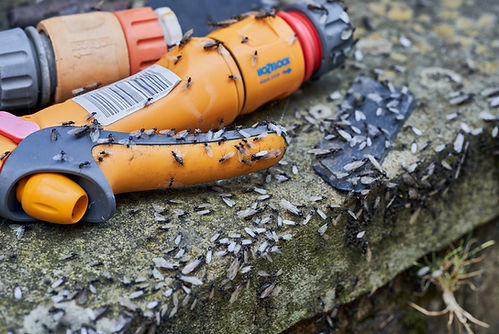
After mating, a female ant may shed her wings and search for a protected place to begin nesting. Suitable locations may include moist soil, cracks beneath concrete, wall voids, damaged wood, or spaces beneath landscaping materials.
Meanwhile, the original colony continues operating.
This can lead to:
- More worker ants entering the home
- Trails developing in additional rooms
- New nesting locations forming around the property
- Repeat swarms during favorable weather
- Ant activity returning after temporary sprays
- Colonies spreading along connected block walls
What looked like a handful of insects near one window can become recurring ant pressure across the yard and interior.
Signs the Colony Is Getting Worse
Flying ants deserve attention when they appear once, but repeated activity makes the source more urgent.
Watch for:
- Winged ants appearing on multiple days
- Swarms occurring in more than one room
- Worker ants traveling near the same window
- Ant trails along exterior walls or foundations
- Winged ants emerging from a baseboard or wall seam
- Queens with shed wings crawling near windows
- Activity around plumbing, sinks, tubs, or dishwashers
- Ants returning shortly after being sprayed
- Several nesting areas around patios or block walls
Finding a few flying ants near an open exterior door may be incidental. Finding a concentrated swarm emerging indoors is a stronger sign that a nesting or access point is nearby.
Why Do-It-Yourself Sprays Rarely Solve Flying-Ant Problems
Spraying flying ants may stop the immediate activity, but it does not address why they appeared.
The reproductive ants are only a small portion of the colony. Most of the workers, larvae, queens, and nesting chambers remain protected underground or inside a concealed void.
Store-bought sprays commonly fail because they:
- Treat the visible ants rather than the nest
- Do not reach ants beneath concrete or inside walls
- Leave queens and developing ants unaffected
- Provide only temporary surface control
- May disrupt trails without eliminating the colony
- Do not correct the moisture or access conditions supporting activity
Homeowners often spray a window, see fewer ants for several days, and assume the problem is gone.
Then the worker ants return from another gap.
That cycle continues because the colony itself was never eliminated.
What Actually Works for Long-Term Flying-Ant Control
Effective control begins with identifying the ant and determining where the activity originates.
A professional flying-ant service may involve:
- Inspecting the swarm location and nearby structural gaps
- Identifying worker trails inside and outside the home
- Examining irrigated soil, block walls, patios, trees, and foundation edges
- Selecting a treatment suited to the specific ant behavior
- Targeting nesting and travel areas rather than only visible insects
- Reducing moisture or landscaping conditions that support colonies
- Monitoring for renewed trails or secondary nesting activity
Baits can be especially useful for certain ant species because workers carry the material back to the colony. Targeted exterior treatments may also be needed where ants are nesting beneath concrete, around the foundation, or in landscaping.
The correct method depends on the ant species and nesting pattern. A treatment that works for one type of ant may perform poorly against another.
The goal is not simply to kill today’s flying ants. It is to interrupt the colony behind them.
Should You Still Be Concerned About Termites?
Termites should remain part of the identification process because confusing the two insects can delay the correct response.
However, finding winged insects does not automatically mean a home has termites. Flying ants are common around Inland Empire properties, especially where irrigated landscaping and protected nesting zones sit close to the structure.
Save one of the insects in a sealed bag or container when possible. Avoid crushing it because the waist, antennae, and wings help with identification.
You should request a closer evaluation when:
- The insects have broad bodies without pinched waists
- All four wings appear equal in size
- Piles of matching wings repeatedly collect indoors
- Mud-like tubes appear along the foundation
- Wood sounds hollow or appears blistered
- Small pellets collect beneath wooden trim
The first priority is accurate identification. Once the insect is confirmed as a flying ant, the focus can shift to locating and controlling the ant colony.
The most effective way to control flying ants in Rialto is to find the mature colony, treat its nesting and travel areas, and stop the conditions allowing ants to reach the home.
Do Not Wait for the Next Indoor Swarm
Flying ants may disappear as quickly as they arrive, but the colony behind them can remain active beneath the yard, inside a wall, or beside the foundation.
If you are seeing more than one indoor swarm or ant trail, there is likely more activity you are not seeing.
TruPest Solutions provides fast service, local expertise, and affordable pricing for homeowners who need dependable flying-ant control in Rialto, California.
We look beyond the insects gathering at the window. We inspect the likely nesting zones, entry points, moisture sources, and outdoor trails responsible for the activity.
Rialto homeowners often notice a meaningful difference after the first service.
Call TruPest Solutions at 951-334-5288 before a nearby colony produces more trails, new nesting sites, or another indoor swarm.
James Understands What a Flying-Ant Swarm Is Really Telling You
James, owner of TruPest Solutions, has 18 years of pest control experience working with ant activity throughout the Inland Empire.
That experience is important because flying-ant control is not based only on what is crawling across the window. James evaluates the entire behavior pattern: where the ants emerged, whether worker trails are present, what moisture sources are nearby, how the landscaping meets the structure, and which openings the ants may be using.
A swarm near an outdoor porch light may originate from irrigated soil or a nearby block wall. Flying ants appearing from an interior baseboard can indicate activity beneath the slab or within a structural void. Ants gathering around a bathroom window may be connected to moisture and plumbing access rather than the window itself.
James understands how ant colonies use Rialto’s concrete edges, block walls, irrigation systems, mature landscaping, and narrow side yards to remain protected from heat.
That real-world knowledge makes it possible to treat the source instead of repeatedly spraying the symptom.
Why Rialto Homes Experience Heavy Flying-Ant Activity
Rialto properties often combine intense heat with regular landscape irrigation. That contrast creates sheltered, moist nesting areas close to homes.
In North Rialto neighborhoods near Las Colinas and the Renaissance area, decorative rock, artificial turf, concrete patios, block walls, and irrigated planters can conceal colonies beneath otherwise clean-looking yards.
In central and southern Rialto, mature trees, older concrete, aging fences, attached garages, and small foundation gaps can give ants multiple routes toward the structure.
Common local problem areas include:
- Block walls shared between neighboring properties
- Narrow side yards that stay shaded
- Sprinkler lines running beside foundations
- Decorative rocks covering moist soil
- Concrete patios added after the home was built
- Tree roots growing beneath walkways
- Garage slabs with expansion cracks
- Wood fences connected to exterior walls
- Air-conditioning drainage areas
- Pet bowls and outdoor food sources
Rialto’s extended warm season also gives ant colonies more time to forage, expand, and produce reproductive ants.
Flying ants may also appear in nearby Fontana and San Bernardino, but every property has a different combination of moisture, shade, construction gaps, and nesting pressure. Local inspection matters because the strongest activity may be hidden in a feature that appears completely ordinary.
What Homeowners Want to Know After a Flying-Ant Swarm
Why do flying ants keep appearing at the same window?
The ants may be traveling toward daylight after emerging from a nearby wall void, foundation gap, or concealed nesting area. The window is often where they collect, not necessarily where they entered.
Are flying ants a sign that an ant colony is inside my home?
Not always. The colony may be outdoors and close to the foundation. However, a concentrated swarm emerging from a baseboard, wall seam, ceiling opening, or window frame can indicate that the colony is within or directly beneath the structure.
Will flying ants lose their wings inside the house?
Yes. Mated females may shed their wings after the swarm. Finding larger ants without wings near a pile of discarded wings can indicate that reproductive ants are searching for a protected nesting location.
Why did the flying ants disappear without treatment?
Swarming activity is often brief. The reproductive ants may leave, die, or shed their wings, while the original colony remains hidden and active. The disappearance of the swarm does not confirm that the infestation is gone.
Can flying ants damage my house?
Most common household ants do not cause the same structural damage associated with termites. However, some ant species can nest in moisture-damaged wood or structural voids. Large colonies can also create persistent indoor trails and spread to additional areas of the property.
The Wings Are Temporary-The Colony Is Not
Flying ants are easy to dismiss because the swarm may end within a few hours.
But winged ants do not appear without a mature colony producing them.
That colony may be beneath an irrigated planter, under a patio, inside a block wall, below the garage slab, or near a small opening into the home. Spraying the insects at the window will not reach the queen or the protected nesting chambers.
Early action makes the source easier to identify before trails spread into additional rooms or new colonies begin forming around the property.
Call TruPest Solutions at 951-334-5288 for fast, affordable flying-ant control backed by 18 years of Inland Empire pest experience.
Find the colony. Stop the trails. Keep the next swarm from appearing inside your Rialto home.