
Argentine ants are common around Rialto homes because hot, dry weather, irrigated landscaping, moisture around foundations. This makes easy access to food and creates ideal conditions for them. The problem usually begins outdoors in soil, beneath landscaping, along block walls, near sidewalks, or around irrigation. You will find ants there before ants will establish trails into kitchens, bathrooms, garages, and other areas of the home. Getting rid of Argentine ants usually requires more than killing the ants you can see. The goal is to identify their travel routes, reduce the conditions attracting them, and use properly placed ant bait that workers can carry back into the colony.
What Are Argentine Ants?
Argentine ants are small, brown ants that form large, highly connected colonies with multiple queens. They commonly travel in heavy, organized trails and are one of the most persistent household ants found throughout Southern California.
They usually do not get a homeowner’s attention because of one ant.
They get your attention when there are suddenly hundreds of them.
The Ant Trail in Your Kitchen Probably Started Somewhere Else
A homeowner in Rialto may wake up, walk into the kitchen, and notice several ants moving around the sink. They wipe them away and assume the problem is handled.
Later that afternoon, the ants are back.
The following morning, there is a steady trail running from a small opening near the countertop toward a cabinet.
A few days later, another trail appears near the bathroom.
That’s when you realize it’s not just one ant wandering inside.
The visible ants are workers searching for food and moisture. The colony supporting those workers can be outside the house and completely out of sight.
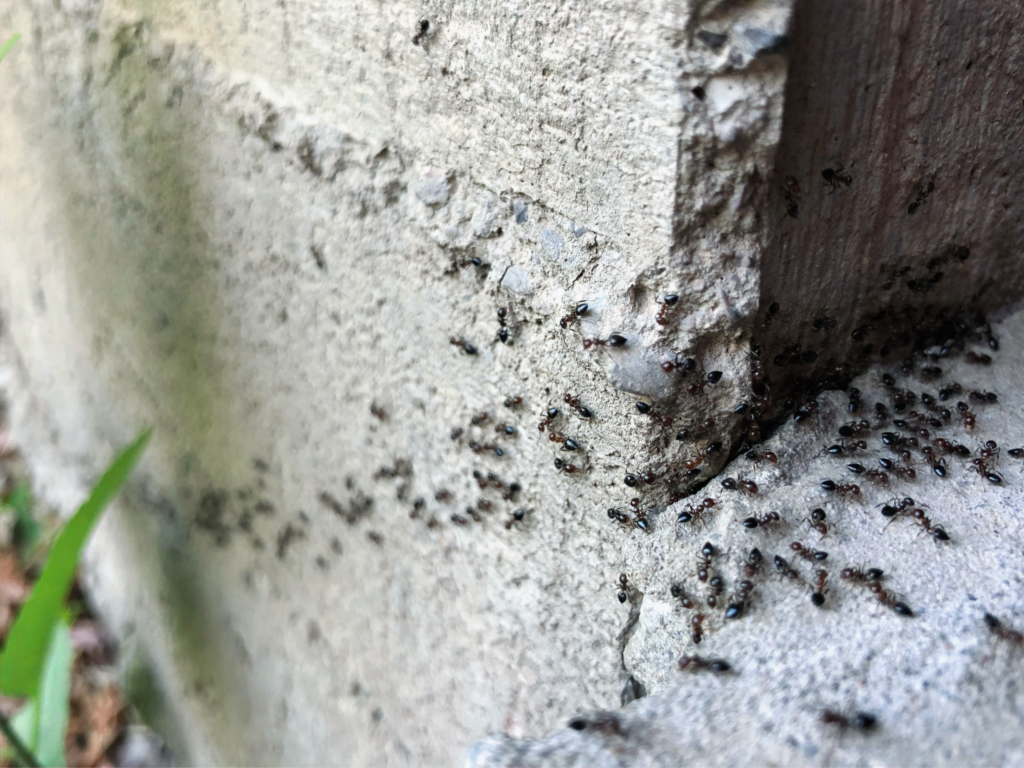
Argentine ant problems in Rialto homes usually start outside and move inward.
Argentine ant infestations grow through organized trails that connect workers with food, water, nesting areas, and the rest of the colony.
Killing visible Argentine ants does not necessarily eliminate the colony producing them.
Why Rialto Conditions Can Create Heavy Argentine Ant Activity
Rialto has exactly the type of residential environment where Argentine ants can become difficult to ignore.
Long stretches of hot, dry Inland Empire weather can increase their search for dependable moisture. Meanwhile, sprinklers, drip irrigation, lawns, shaded soil, planter beds, leaking hose bibs, and landscaped areas can provide moisture close to the house.
Argentine ants show up in Rialto because hot, dry conditions and irrigated residential landscaping give colonies dependable places to survive, which leads to workers traveling toward homes when they find better sources of water, food, or shelter.
Weather changes can make activity seem sudden as well. Extreme heat can drive ants toward cooler or wetter locations, while heavy watering or rain can disturb existing nesting areas and change where the ants travel. Argentine ants commonly seek food, water, shelter, or relief from hot, dry and flooded conditions.
That is why you can have almost no ants in the kitchen one week and a major trail the next.
Where Argentine Ants Hide Around Rialto Properties
Finding the ants inside is only part of the inspection.
Outside, activity may be hidden in moist soil around irrigation lines, underneath landscape materials, beside concrete slabs, beneath potted plants, along driveway and sidewalk edges, around the base of block walls, near utility penetrations, underneath debris, and close to shrubs where aphids and other honeydew-producing insects are present.
Around the structure, workers may travel along foundation edges, plumbing penetrations, expansion joints, door thresholds, window frames, utility lines, cracks in stucco, and small gaps where exterior materials meet.
Once indoors, trails can appear around:
- Kitchen sinks and countertops
- Dishwashers
- Pantry shelving
- Pet feeding areas
- Bathroom sinks and tubs
- Laundry rooms
- Baseboards
- Window frames
- Plumbing openings beneath cabinets
- Attached garages
The trail you see indoors can be only the final few feet of a much larger route.
How a Small Ant Problem Turns Into Multiple Trails
This is where Argentine ants can become frustrating.
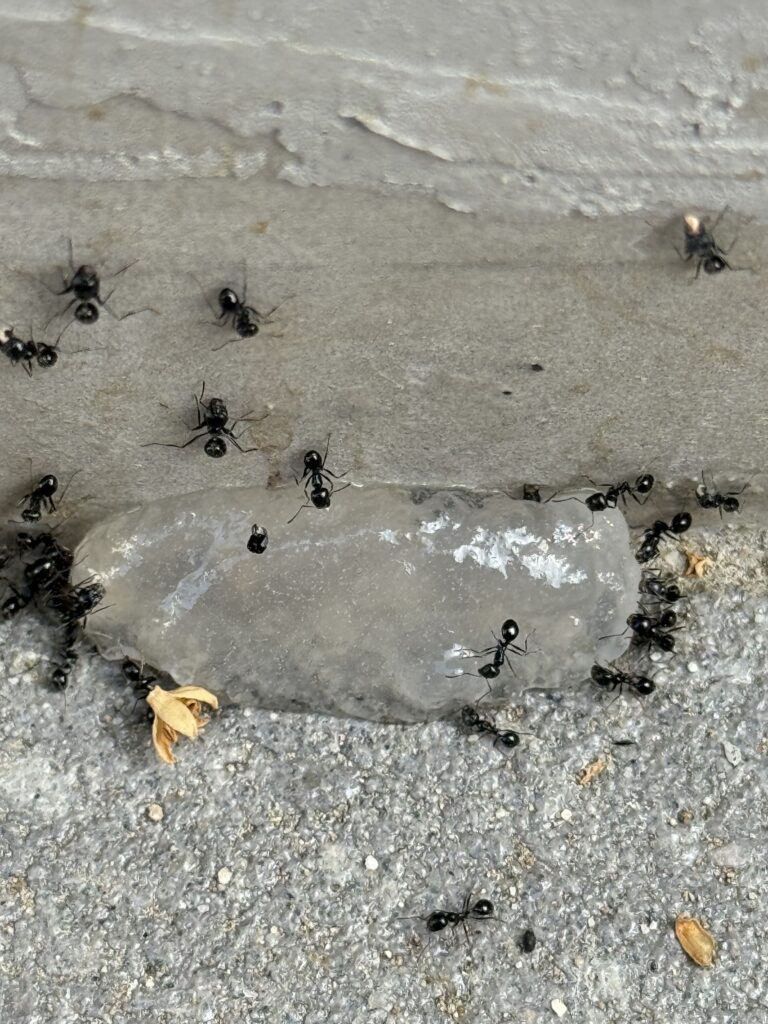
One worker finds something useful water near the sink, a sugary spill, pet food, grease around an appliance and other workers begin following the established trail.
At first, you might see five or ten ants.
Then you start seeing them every morning.
After that the trail gets heavier.
You start seeing them in multiple areas: the kitchen counter, bathroom, pantry, garage, or around the exterior walls.
At that point, repeatedly wiping away visible ants may give temporary relief without changing what is happening outside.
Argentine ants are especially challenging because their colonies can contain multiple queens and can be spread across extensive outdoor nesting areas.
That colony structure is one reason a surface-level approach can fall short.
Why Spraying the Ant Trail Can Give the Wrong Impression
A spray can make the problem look solved very quickly.
You spray a line of ants. The ants die. The counter is clear.
It feels successful.
But those ants were the workers that happened to be outside the colony at that moment.
UC IPM notes that insecticide sprays can provide temporary control, while slow-acting bait allows workers to carry the active ingredient back toward other members of the colony.
That difference matters.
When dealing with Argentine ants, the question should not only be:
“How do we kill these ants?”
A better question is:
“Where are these ants coming from, and how do we get control beyond the visible trail?”
Why Ant Bait Can Work Better for Argentine Ant Colonies
Ant bait takes advantage of the ants’ own behavior.
Instead of immediately killing every worker that approaches the treatment, an effective bait is designed to be attractive enough for workers to feed on and slow enough that they can carry it away from the bait location.
That is exactly what you want.
The worker becomes part of the control process.
Argentine ants are particularly attracted to sweet liquid baits throughout much of the year, although food preferences can shift.
Proper bait selection, placement, freshness, competing food sources, and the size of the infestation all affect performance.
UC IPM also recommends primarily placing baits outdoors near nests, trails, and foundations rather than automatically drawing more ants farther indoors.
And bait does not necessarily mean putting one small station on the kitchen counter and hoping for the best.
For a significant infestation, the exterior activity needs to be understood.
“The Ants Are Eating the Bait Why Are There Still So Many?”
This is one of the most important things homeowners should understand about bait.
Seeing ants actively feeding on bait can actually be part of the process.
Homeowners sometimes panic because there appear to be more ants around a bait station at first.
They assume it is making the infestation worse and spray the trail.
That can interfere with what the bait was intended to accomplish.
Bait-based control is deliberately different from immediate-contact control.
Workers need an opportunity to feed and move back through their normal routes.
UC IPM notes that reductions may take several days and complete control can take longer depending on the severity of the infestation.
The objective is not simply a clean countertop for the next two hours.
It is longer-term suppression of the ant population feeding that countertop.
What Actually Works for Long-Term Argentine Ant Control
Professional Argentine ant control should begin with figuring out what the ants are doing around the property.
That means looking for active trails, nesting areas, moisture, landscaping conditions, entry points, competing food sources, and locations where workers are moving between the yard and structure.
From there, treatment can combine properly selected bait with targeted exterior control, sanitation recommendations, moisture correction, vegetation management, and exclusion of entry points where practical.
Baits by themselves are not a substitute for correcting the conditions supporting an infestation. Removing food sources, reducing unnecessary moisture, eliminating easy access routes, and targeting exterior activity all improve long-term control.
That is the difference between chasing ant trails and actually managing the problem.
Stop the Trail Before It Spreads Through the House
If Argentine ants are already making regular appearances inside your Rialto home, waiting usually gives the colony more opportunities to establish dependable routes to food and water.
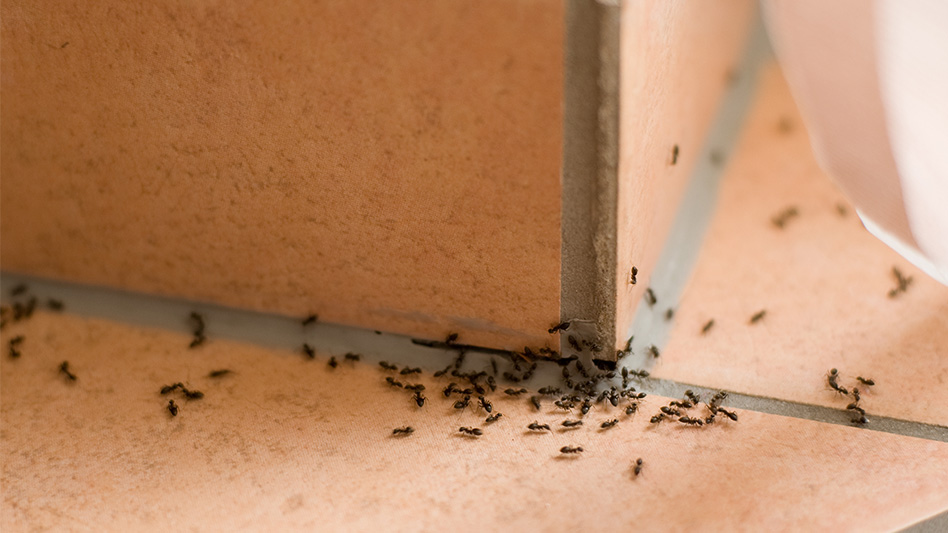
If you’re seeing more than one ant trail, there’s likely more activity you’re not seeing.
Call TruPest Solutions at 951-334-5288 for fast service, local expertise, and affordable pest control in Rialto, CA.
We inspect where the ants are coming from instead of simply treating the few workers walking across the counter.
Many homeowners notice a clear difference after the first service, especially when treatment reaches the areas where pest activity is actually originating.
Whether you need an exterminator in Rialto for an active infestation or ongoing bug control in Rialto to prevent recurring problems, getting ahead of the colony is much easier than waiting until ants are moving through several rooms.
Why James Looks Beyond the Ants You Can See
James, owner of TruPest Solutions, brings 18 years of pest control experience to homes throughout the Inland Empire.
With Argentine ants, experience matters because their behavior can tell you a lot about what is happening beyond the visible trail. The direction workers are traveling, where activity increases around the structure, nearby irrigation, vegetation, moisture, weather changes, and even what the ants are feeding on can influence the treatment approach.
A heavy trail beside a Rialto block wall calls for a different inspection than several workers appearing underneath a kitchen sink.
James’ approach is built around understanding those patterns first and treating accordingly not automatically applying the same treatment to every ant problem.
That real-world understanding of Inland Empire pests helps TruPest Solutions determine where activity is starting, why it is continuing, and what needs to change to reduce the chances of another invasion.
Why Rialto Homes Give Argentine Ants So Many Travel Routes
Rialto properties have their own recurring ant trouble spots.
Homes with block walls can give ants long, protected travel corridors through adjoining yards. Narrow side yards often contain irrigation equipment, trash cans, AC condensate, hose connections, utility lines, and shaded soil within only a few feet of the structure.
Older properties around central Rialto may have small gaps, mature landscaping, established irrigation, and numerous potential entry points. Newer homes are not immune either decorative landscaping, drip systems, attached garages, slab edges, and neighboring properties can all support ant movement.
Properties near Riverside Avenue, Baseline Road, Foothill Boulevard, and throughout north and south Rialto can experience the same basic pattern: outdoor colonies establish themselves where moisture and food are dependable, then workers exploit tiny routes toward the house.
The same Argentine ant problems are common throughout nearby Fontana, CA and San Bernardino, CA, but understanding the individual property is what allows treatment to be more precise.
When homeowners search for how to get rid of Argentine ants in the Inland Empire, the answer usually starts outside not with another can of spray underneath the kitchen sink.
Rialto Homeowners Ask Us These Argentine Ant Questions
Why do my Argentine ants disappear and then suddenly come back?
The colony may never have disappeared. Changes in temperature, irrigation, rainfall, food availability, and moisture can change where workers forage. You may stop seeing an indoor trail temporarily while substantial activity continues outside.
How can I tell if my ant problem is getting worse?
Watch for heavier trails, activity returning soon after cleaning, ants showing up daily, or separate trails appearing in additional rooms. Finding ants in the kitchen and then later in bathrooms, bedrooms, or the garage often indicates that the problem extends beyond one food source.
Why aren’t the bait stations I bought getting rid of the ants?
The bait may not match what the ants are currently attracted to, it may have dried out, competing food may be available, placement may be poor, or the infestation may be larger than a few consumer stations can effectively address. Argentine ants generally respond well to sweet liquid baits, but bait selection and placement still matter.
Are Argentine ants dangerous if they’re coming into my kitchen?
Argentine ants are primarily considered nuisance pests rather than stinging ants, but a persistent trail through food-preparation and storage areas is still something homeowners should correct. Frequent indoor activity is also a sign that workers have found a reliable resource or entry route.
Should I spray the ants while they’re feeding on bait?
Generally, you do not want to spray the ants or their trail around a bait placement. The entire purpose of a slow-acting bait is to allow workers to continue feeding and carrying material away from the bait site. Spraying those workers can interfere with that process.
Don’t Let One Ant Trail Become the New Normal
Argentine ants can make a small problem look harmless right up until trails begin appearing in different parts of the house.
By that point, repeatedly killing the ants you can see is usually treating the symptom instead of addressing the source.
The most effective way to control Argentine ants in Rialto is to identify the exterior activity early, target the colony with the right treatment strategy, and reduce the conditions allowing ants to keep reaching the home.
If ants keep returning, are appearing every day, or have started moving into multiple areas, now is the time to address them.
For professional pest control in Rialto, CA, call TruPest Solutions at 951-334-5288.
Get ahead of the colony before the next trail finds its way inside.